Monday, March 8, 2010

OPTIMISM AND INITIATIVE

This class is a pilgrimage with no foreseeable path. With no definite end. It is a journey that despite having marked stops, assignments, goals, and activities, constantly changes and is unexpected. At times we may resent this journey, we may not see the necessity of what we are doing. But until the end, until we have truly hammered these thoughts, these days, these discussions into unity, we won’t really know what we’ve gotten. This is the biggest and most significant similarity I see with Siddhartha. We are here to engage in an “independent inquiry,” although it is guided we are encouraged “to think for [ourselves], decreasing reliance on secondary sources, practicing what is known as active, experiential or discovery learning.” This is the only way to reach our destination and to answer the question “who are you?” Just as Siddhartha had to go through years of experience to learn that he could not be taught, we are being taught that experience is the only way to learn. In Siddhartha’s case, “no teacher would have ever been able to bring about his salvation (94),” and it’s the same here, we can really only get out of this class what we put in. So it is in college and in life.


We may get unruly in our attempts to

shape our own education.

source: http://bumataystudio.com/cc/class08.jpg


To get the most out of anything we must learn “how to maintain a pro-active, positive attitude.” Siddhartha is a great example of this. Even though he reached his lowest possible point, at the brink of ending everything, he was able to come back out of it with an even more positive outlook than before. This teaches us that we’re only at the beginning of our journey and can’t go forward in constant fear of failure, because such failures are inevitable in life, and are only opportunities to grow. We can help ourselves by remembering the power of love vs. fear, which is a theme of this course. Hopefully we can come to a place where we are “only interested in being able to love the world (137),” for we will never be able to change it unless we first accept it for what it is.


Both of these things play into our leadership essay. A leader must be a self-propelled learner and an optimist. We must learn “by creativity rather than going through the motions, by curiosity rather than compulsion” if we wish to be leaders in any field. I personally feel that leadership comes from having creative solutions to problems and being willing to take risks to let those solutions come into reality. Siddhartha displays this trait of a leader completely. He is never satisfied with pre-existing knowledge; he must solve the problems of his identity and of the universe through his own methods.


Another theme in Siddhartha pertaining to leadership, especially option two of our essay, is the importance of listening, also one of the course goals. Vasudeva represents this trait in the book, and we, just as Siddhartha did, can learn a lot by his example - “without him saying a word, the speaker could sense how Vasudeva let words enter his mind, how he was quiet, open, and waiting, and how he did not lose a single word by impatience (98).” The ability to listen is a key factor in “the composition of self, the construction of character” that we must pursue in order to become better leaders for the benefit of society.


We can learn a lot about leadership by listening.

source: http://wheredothechildrenplayla.files.wordpress.com/2009/10/listening-to-nature.jpg


One of the most intriguing aspects of essay four is the consideration that “the trait, role, or goal you are discussing is but one of many possibilities radiating out from your center, from the core of your being.” This was one of the ideas that resonated most fully for me in Siddhartha and which gives me much optimism as to developing future goals and plans. As someone who changes her path constantly, I like the idea of infinite potential.

Thursday, March 4, 2010

SIDDHARTHA DISCUSSION OUTLINE

It’s going to be a beautiful day, so let’s go outside.

Our meditation today: listening to music
By focusing our upper-mind on listening to repetitive, calming sounds, we can better focus our lower thoughts, or our subconscious thoughts, and perhaps reach a state of focused, calm, energy.

AND NOW TO CONTEMPLATE SIDDHARTHA’S JOURNEY TO INNER PEACE:

What is the significance of Siddhartha’s pilgrimage and how does it relate to your life?

His position afforded him luxuries which many people can’t have which undeniably altered his path
-Katherine

If Siddhartha had not acted on his decisions, if he had not lived with the Samanas or merchants, he never would have been able to make his own judgments on life
-Helen

As how Siddhartha learned an immense amount of wisdom from listening to the river, we can learn from keeping an open mind and listening to the ones we meet on our pilgrimage
-Jade

He had spent his entire life on a journey seeking spiritual enlightenment, just as I had spent my entire life on a journey to become an Olympic swimmer. I felt so much pressure to please the people around me, to not let them down, that I tortured myself to reach that goal
-Spin

This idea of unified change throughout life, of one person really transforming into many different people, is not a completely unfamiliar one
-Lauren

I do not think I could achieve enlightenment just following this simple path
-Emily

What did Siddhartha’s pilgrimage accomplish? Was it a necessary path to take?

I think that the human ability to transform ourselves, to mature, to become (hopefully) better, more caring people as we grow older, to gain wisdom through living life, though "it can't be expressed or taught in words" (Hesse, 132), is special.
-Lauren

We will be continuously seeking. Yet while obsessing over achieving a goal, we will not be open to the answers all around us
-Jade

Siddhartha spends a majority of the novel over thinking his life, tackling everything with a philosophical and spiritual approach. Eventually, he learns the wisdom of just letting things “be”
-Chris

Siddhartha and I both realized that this journey we were so desperately trying to make reach a “perfect” climax was not something that can be forced. It is something that - when you let go, relax, and just let it flow like a river - comes naturally.
-Spin

There is no “right!” We can search all we want for the true path, but we’ll “never stop searching.”
-Katherine

Is suffering necessary to reach a state of inner peace? What constitutes suffering?

Oftentimes we must go through hardships to find what our true beliefs are
-Jade

I am not entirely dissatisfied with the world—I see room for improvement, but I understand that I am a part of this world and I can work to improve it instead of setting myself apart.
-Emily

“I’ve had to experience despair […] in order to be able to experience divine grace,” (Hesse, 91) and it has definitely been worth it.
-Spin

Is suffering a byproduct of love? Is this why the ‘childlike’ people cannot escape from their suffering?

Siddhartha’s struggles with his son mirrors lovesickness in many ways–the devotion, envy of others’ happiness, loss of self
-Molly

How does unity lend itself to all encompassing love?

I continue to seek to see all things, all beings of the world, with love and appreciation
-Helen

Wednesday, March 3, 2010

EVERYTHING IS.

Today has been radiant. Today has been reaffirming, beautiful, unified, and complete. The sun is shining on my back, the grass is cool and soft, dandelions are perking up around me, bees going about their labor. I have been joyful all day. This is how the world should always be. Even in inclement weather, witnessing life around me should be the ultimate source of joy, and it often is.


Enjoying the beautiful day outside.

photo credit to author


Why did it take Siddhartha so long to find what he was seeking? This is the main question I have of his pilgrimage. I feel he knew his conclusion all along. But I suppose this is the lesson of misguidance. He knew where truth lie, but he was diverted from it by lessons and words, constructed dichotomies, and the pursuit of quantifiable meaning. Aren’t we all… I find myself retracing my own steps, through philosophies, sciences, teachers – all meaningful, none satisfactory. But these are the paths we are left to take. It is frustrating and circuitous sometimes to seek all within yourself, it is an easy task to give up on. We must find where to take our measurements, when to pin down the constant inner monologue that is the truth as it exists from moment to moment. But what we most often find is that those moments contradict each other. It is living in the contradiction, not trying to reconcile everything.


Because everything is. It’s a simple lesson that Siddhartha learns through a complicated life, and a lesson I often fall back on. I suppose it may seem trivial, naïve even, to be content with such an explanation. But it is so obvious when you sit and listen and observe that being is enough. Being as everything else is. This satisfaction with existence as it is – and whatever that implies – has many applications in our dealings with one another. The “awareness and conscious thought of the unity of all life (p.121)” brings us to realize that we are all of the same material and have the same potential for existence in one form or another, or in no form. By recognizing that potential, we recognize something worth loving and admiring in everything and everyone around us. As siddaharttha tells govinda, “one has to worship within themselves, in you, and in everyone else the buddha which is coming into being, that is possible (p.133).” In this case I take the Buddha to mean our potential for pure love and happiness, for a state of nirvana so-to-speak. By seeing this potential we are “able to look upon it and [ourselves] and upon all beings with love, admiration, and great respect (p.137).”


We are all part of one earth, one universe.

source: http://greenerloudoun.files.wordpress.com/2008/01/nasa_earth.jpg


It is difficult to achieve this in a society that is based on competition, or in Siddhartha’s case, a society based on the differing values of individuals according to a caste system. So it is a cycle we must escape from, like samsara, but must still appreciate as a manifestation of the perfect universe we exist in. Although Siddhartha experienced the negative consequences of living in the sin of “the childlike people”, he still “saw people living for themselves, saw them achieve an infinite amount for themselves, saw them travel, wage war, suffer an infinite amount, and endure an infinite amount. He could love them for it, and he saw life and that which is alive - in each of their passions and actions (p.121).” So we must let go of our judgments and classifications, and allow everything to exist in its current form with the knowledge that it has the potential to occupy any form, including our own. I hope that despite our attempts to categorize the world, to explain the minutae of life, we can “learn to leave the world as it is, to love it, and to enjoy being a part of it (p.134).”

Monday, March 1, 2010

FALLING LEAVES

Our lives are rife with contradictions. We shift from one personality to another, always aware of our own identity but never really experiencing what it means to be alone with ourselves, or within ourselves. And so it is difficult to fix ourselves to a path, or a set of goals, without being influenced by the outside world. But it seems as though if we could be determined in all of our actions, if we could channel all our energy into a singular purpose, we could achieve anything with ease. We would be like Siddhartha, whose “goal attracts him, because he doesn't let anything enter his soul which might oppose the goal (p.59).”

But how do we reach this state of being? Even Siddhartha, after going through the rigors of ascetism and the learning of a Brahmin, cannot hold onto the sublime state of moving independently through life. What hope do we have, constantly bombarded with materialism and fed the opinions of others? We are indeed “like a falling leaf that is blown and is turning around through the air, wavering and tumbling to the ground (p.69).”

Even after becoming a samana,
Siddhartha did not find nirvana.
source: http://www.wikiwak.com/image/Ascetic+Bodhisatta+G
otama+with
+the+Group+of+Five.jpg

Hesse’s book has given me a lot to contemplate thus far, and I am curious to see how this problem gets resolved. How does one hold onto a supreme sense of self, capable of overcoming any worldly trial, without becoming completely detached from the actual world of humanity? We must constantly sacrifice parts of ourselves to function within a society; I watch it happen everyday. We must then decide if that loss is outweighed by what we gain from human interaction – whether it is a physical relationship like that between Siddhartha and Kamala or a deep friendship like that between Siddhartha and Govinda. I think that the balance depends on surrounding yourself with the right people. Siddhartha maintained his love for Kamala because he saw in her a similar soul, but had to sacrifice that relationship because he was disillusioned by the other people he had to interact with.

We are all like falling leaves.
source: http://problemamuslim.files.wordpress.com/2009/05/falling_leaves.jpg

I can relate to Siddhartha in many ways. His constant yearning for an ultimate knowledge and his revelation that certain types of knowledge are not to be attained by learning mirrors my own. I have sought much by looking first inside myself rather than looking towards others, and like Siddhartha, “my trust in words that come from teachers is small (p.25),” not out of disrespect, but out of an understanding of the relativity of truth. I face many of the same contradictions in my daily life as Siddhartha, mainly in my attitudes towards other people and the importance of the self in attaining a nirvana-like state of existence. Sometimes I feel like Siddhartha felt when “he saw mankind going through life like a child or an animal that he both loved and despised at the same time (p.67).” I often feel disconnected from the culture I’m entrenched in, despite being a large participator in its daily manifestations. In the end, my goal is happiness, the cessation of suffering, and as Hesse’s book reaffirms, a weighing mind and constant moderation is a way to attain that goal.

Thursday, February 25, 2010

MORAL IMPERATIVES FOR ENVIRONMENTALISM

What is the point of viewing environmentalism from a religious perspective? Does their correlation support the validity of environmentalism, of religion, or of both? I think that this task of trying to find a moral imperative to be environmentally conscious overlooks the scientific fact of man’s place in nature. If we destroy our planet, we won’t be able to live on it, plain and simple. I don’t really understand why this logic isn’t enough to encourage people to think more sustainably towards the future, but since it obviously isn’t, we must create moral imperatives for them in the only thing they seem to believe blindly, religion.

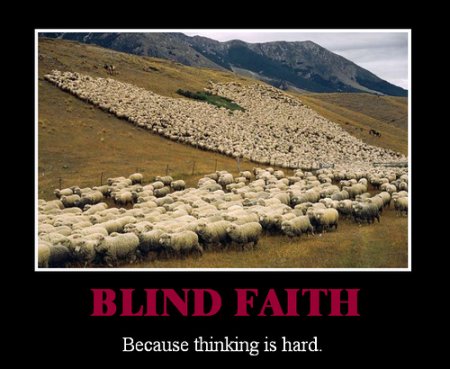
Religious faith is sometimes the only source of moral imperative

source: http://petursey.files.wordpress.com/2009/10/blind-faith.jpg


We’ve already discussed Western religion’s role in this, and how its view of compassion can be selectively applied. In Jainism, however, who, or what, the moral code protects is strictly delineated. Following the path of Ahimsa, humans must not harm nor think of harming any living thing, plant or animal. This comes from “the development of a mental attitude in which hatred is replaced by love (236).” Love for all things and people within creation, stemming from a shared divinity of life. The implications for this in environmentalism are obvious. However, such a path is not enough to mitigate the affect man has on the environment. Would a Jain monk understand the long term implications of releasing carbon dioxide from burning fossil fuels? Or the interruption of natural land progression by suppressing the periodic burning of scrubland? What about the overpopulation of deer which results in the end of oak regeneration? In these instances, ahimsa is not enough, unless coupled with a deeper understanding of the implications of all our actions, not just those that result in the direct destruction of life.


Jainism does have a positive effect overall when put in the context of human relations. The idea that “one self dwells in all… by serving another, you serve your own self (237)” speaks to the unity of man as a species. From that perspective, ecology arises once again as a central issue. If we are all each other’s protectors, if we all dwell in a singular self of existence, then we have a responsibility to maintain a suitable environment for that singular self to continue to exist. Thus we protect the environment for the future success of human life.


What are we leaving for future humans?

source:http://www.thedailygreen.com/cm/thedailygreen/images/beautiful-nature2-pp-www-lg.jpg


But what does this interpretation say of morality? That it is fueled by self-interest? I don’t think most Jain scholars would agree, from what I have read in the anthology and on the theory of ahimsa in general. In the essay on Jainism and ecology it argues that “we have a moral obligation toward nonhuman creation (145).” But where does that morality come from? Is it a spiritual creation, a respect for the divine natural world, or a humbled view of human accomplishment in the face of nature? This does not seem self-serving, but rather depreciative of humanity, and I think this is one of the main differences in Eastern and Western spiritual tradition. As the essay says, “the most urgent task of both science and religion is to assert the unity and sacredness of creation, and to reconsider the role of humans in it (245),” and I believe that Jainism fits that role. In western tradition, however, the sacredness of creation has been asserted, but man continues to dominate its trajectory.


It is a good question to ask what role man is to play in the “divine” theatre that is nature. Will we be shepherds or slaughterers? Will we take what we need, or take what we want? We recognize the importance man has in interacting with nature, caring for it, using it to serve the species, as it states “agriculture is the noblest profession (241),” but where do we draw the line? What perspective do we take on the environment and our responsibility, our moral imperative, to protect it? When viewed from a spiritual perspective, we must consider where divinity lies, or to be less secular, where the beauty of creation is manifest. And this is the difference between eastern and western thought, for in the east divinity lies in all nature, but in the west it lies in man and in gods work through man. So if we could merge these two perspectives, superimpose them on one another, we’d be left with a question similar to Professor Bump’s: “who would not be upset if a saint was lopped, maimed, and killed? (222)” The only difference lies in who your saints are, but regardless, it is agreed that the divine should never be destroyed.


Nature is divine.

source: http://static.flickr.com/63/171449609_ca3f8640df.jpg

Wednesday, February 17, 2010

RELIGION AND THE ENVIRONMENT


At first glance, there might not seem to be much of a correlation between religion and environmentalism. However, as we saw in our own discussion of spirituality, many of us have a profound connection with our natural world, in the presence of which we often feel closest to the divine. But how is that feeling reflected in religious doctrine itself? And how can this correlation be used as a tool to foster environmental awareness?


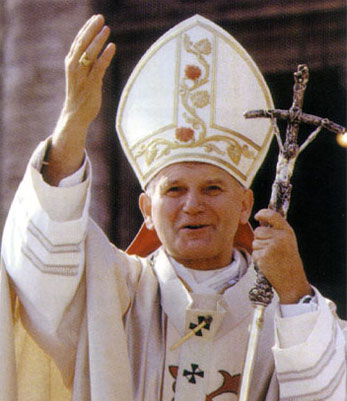
Western religions don’t have the best reputation for being environmentally conscious. Recently there have been adjustments, such as the Pope making pollution and environmental degradation an “official” sin, but overall, and judging by the bulk of their doctrines and practices, there is little room in their moral code for the protection of any life, or any environment, that isn’t human. As the essay on ecology and world religions stated, “religions have traditionally been concerned with the path of personal salvation, which frequently emphasized otherworldly goals and and rejected this world as corrupting (anthology, 28).” In most western religious tradition the moral code is focused on human interaction, and hu

mans are the only ones created in the image of god, and thus at the top of the hierarchy of life. And so the only way to relate western religion to environmental responsibility is through its human components. If we destroy our world now, where will our children and the children of our brother’s live tomorrow? A hint of this reasoning can be found in the Qur’an, as quoted in the anthology, “live in this world as if you are going to live forever: prepare for the next world as if you are going to die tomorrow (30).” But still, the concept of an afterlife makes it much easier for people to overlook the degradation of this life. As does God’s command in Genesis: "be fruitful, multiply. Fill the earth and conquer it (115).”

The Pope made pollution a sin,

but does that really reflect

catholic doctrine?

source: http://www.polishamericancenter.org/Pictures/pope-new2.jpg


The whole relationship, or rather disconnect, between god, man, and the environment creates many hurdles to using religion as a motivator in increasing environmental awareness. From the very start, man is separate from nature. However, in eastern tradition these separations stop. Man enters the world machine and is part of the cyclical whole of the environment and the cosmos. In this way eastern tradition is more conducive to celebrating a symbiosis with nature, and conservancy becomes the natural course of man.

The might of nature.

source: http://www.treehugger.com/forest-nature-scene.jpg


Despite differences in the two philosophies, it can’t be denied that religion is a powerful tool to promote certain actions of the part of the individual. By tapping into one’s spiritual beliefs, you tap into their sense of purpose, of duty, and of legacy. One thing that flows through all beliefs and all people, however, is the awe and power of nature as we experience it on earth. As Virgil says “see how it totters- the world's orbed might, earth, and wide ocean, and the vault profound, all, see, enraptured of the coming time! ah! might such length of days to me be given (124).” Even in the face of all our ascribed divinity and doctrine, nature still dominates our current space, and we cannot avoid the fact that the world around us will outlive us, whether we work towards saving it or not. Our bodies will die, and go back into the larger system of the earth, regardless of the destination of our souls.

Monday, February 8, 2010

THE END POINT OF A CIRCLE

In the second half of Life of Pi we are shown the ultimate end to suffering. We are shown what happens when we are left alone, how we manifest in a new, displaced reality. Again the idea of humanity comes into question. What is the universal truth that so separates us from animals? In Pi’s case, that truth is relative. As is all truth when looked at through the lens of the ultimate end – the end of loss, complete separation from past identity, it is the end that is not death of body but a reemergence from the death of soul, or rather, the splitting of a soul.

Could Richard Parker be an alternate
reality for Pi's sense of self?
source: http://thebeliever07.files.wordpress.com/2008/07/parker460.jpg

Pi’s end comes from an early realization that, “when your own life is threatened, your sense of empathy is blunted by a terrible, selfish hunger for survival (p. 151).” In his story he first loses an empathy that was once so easily engrained – vegetarianism – and later an empathy with far more profound consequences. Richard Parker lurks through this new reality, an example of unrestrained determinism, and a symbol of fear for Pi. But what does the tiger on the boat threaten? We do not know if it is threatening Pi’s survival of body, or whether it threatens to overtake his moral soul. Perhaps the threats go hand in hand, and so once again, in the end, the truth may remain relative.

And what of Pi’s loss? He maintains his body. He maintains a will. A wit. A God. Even a scrap of sociability. But he does lose something profound on the boat, he loses his mother. And what is more of an ultimate end than that? Pi says, “to lose your mother, well, that is like losing the sun above you (p. 160).” This is the final straw to sever pi from his place, to leave him disoriented in reality, and to start anew with another narrative, not of loss but of sacrifice. For a maternal chimpanzee is not a mother, a wounded zebra not a young sailor. And so the loss is not the same. It is not so much a loss at that point as it is a trade off, one life for another. Even to a zookeeper’s son, or especially to him, the circle of life is a firm reality, that is until man, until Pi, turns into the end point of the circle – and thus must work against it.

Pi suffers. Pi is lost. Pi is displaced, disoriented, removed. Yet Pi lives, and what is the most striking thing left in his life? It his ability to tell a story. To create a story where God exists, from a situation in which God, to most of us, would seem so far away. The most striking thing left to Pi at the ultimate end of his suffering is this realization – truth is relative. Truth is relative to the end one wishes to achieve. Pi’s end is the same no matter the narrative, and he asks of his interrogators, “which is the better story, the story with animals or the story without animals? (p. 398)” Which is the better story, the better truth? In the case of ultimate suffering, it does not matter the means to the end. A soul is left ripped open, split, allowed to create whatever meaning it so chooses. And the meaning it chooses is the meaning that keeps some semblance of human wholeness, of order, of will. And yet it is the realization that these semblances are but that, mirages on an open sea, that affirms in the end the triviality of distinction. All that is left of life is to live, so it went with Pi, “and so it goes with God. (p. 399)”
In the end absolute truth should never
be sought nor found.
source: http://www.therawdivas.com/HHH/images/truth-nextexit.jpg